NGL Meaning in Text: What Does NGL Mean in Chat?
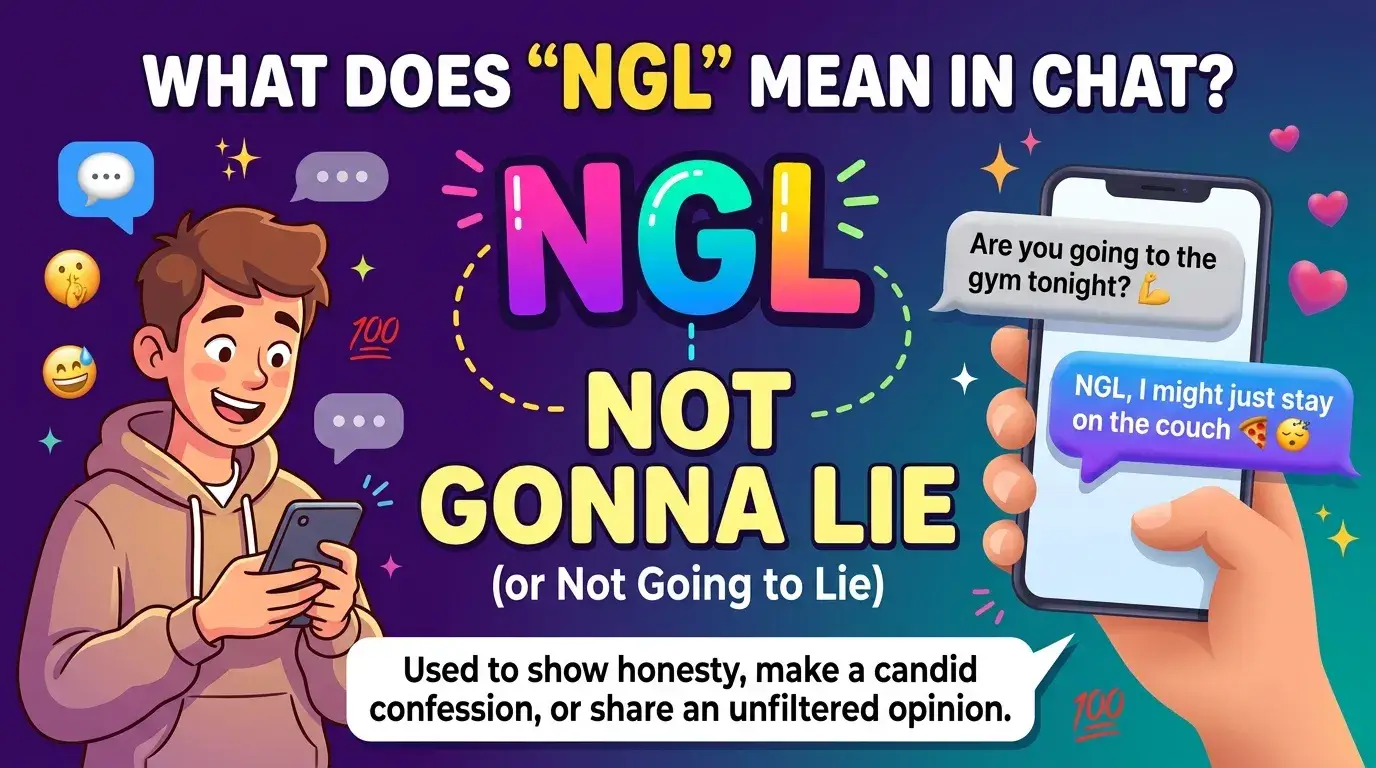
NGL means “Not Gonna Lie” in text messages and online chats. People use this text slang to share an honest opinion, express a real feeling, or say something openly in a casual way.
Meaning / Definition
The NGL meaning in text is “Not Gonna Lie.” It is a common chat abbreviation used on social media, in text messages, and during online conversations.
People often use NGL before sharing an honest thought, personal opinion, compliment, or confession. It can also introduce a surprising statement or a comment that someone might feel shy about saying.
Example: “NGL, this movie was amazing!”
In this example, the person is saying that they honestly enjoyed the movie.
Meaning in Simple Words
NGL simply means “I’m being honest” or “To be honest.”
Think of it as a short way to tell someone that you are about to share what you really think or feel. Instead of typing a long sentence, you can use three simple letters: NGL.
For example:
- “NGL, I’m tired.” means “To be honest, I’m tired.”
- “NGL, you look great.” means “Honestly, you look great.”
- “NGL, I don’t like this song.” means “To be honest, I don’t like this song.”
NGL is informal, which means it is best for casual conversations with friends, family members, or people you know well.
It is popular in text messages, TikTok comments, Instagram posts, Snapchat chats, Discord messages, and other online spaces.
Real-Life Examples of NGL in Text Messages
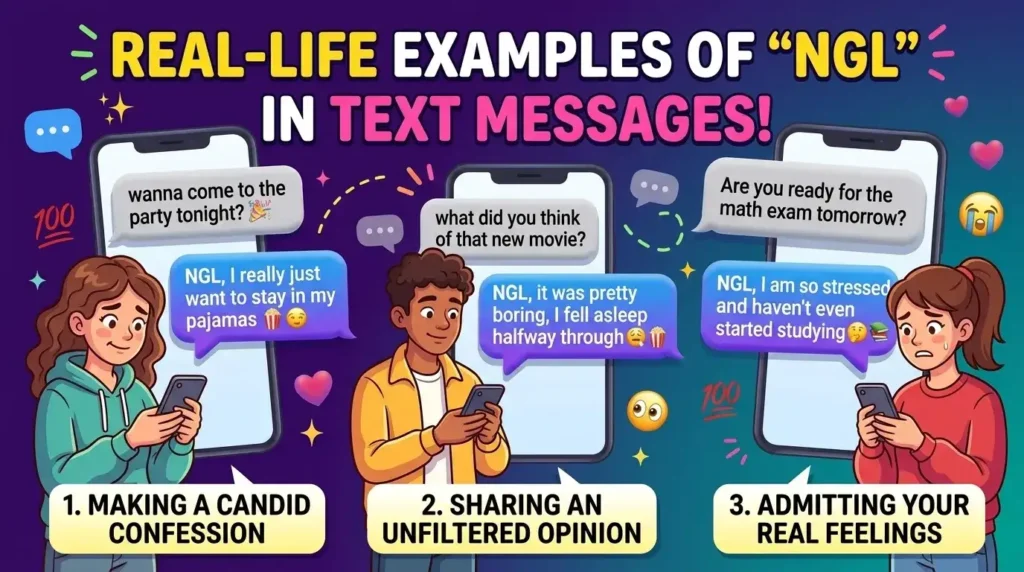
The best way to understand NGL is to see how people use it in everyday conversations. Here are 10 realistic examples with simple explanations.
1. Sharing an Honest Opinion
Friend 1: Did you like the new movie?
Friend 2: NGL, it was better than I expected.
Meaning: The person is honestly saying that they enjoyed the movie more than they thought they would.
2. Giving Someone a Compliment
Friend 1: Do you like my new outfit?
Friend 2: NGL, you look amazing!
Meaning: The person is giving a sincere compliment and saying that they genuinely like the outfit.
3. Talking About Food
Friend 1: Have you tried this pizza?
Friend 2: NGL, it’s the best pizza I’ve ever had.
Meaning: The person is expressing their honest opinion about the pizza.
4. Expressing Tiredness
Friend 1: Are you coming to the party tonight?
Friend 2: NGL, I’m too tired to go out.
Meaning: The person is honestly explaining why they do not want to attend the party.
5. Talking About School
Friend 1: How was your math test?
Friend 2: NGL, it was really difficult.
Meaning: The person is sharing their true feelings about the test.
6. Sharing a Secret Feeling
Friend 1: Do you miss your old school?
Friend 2: NGL, I miss my friends a lot.
Meaning: The person is openly expressing an emotional feeling.
7. Talking About Someone You Like
Friend 1: Do you like anyone right now?
Friend 2: NGL, I think I have a crush on someone.
Meaning: The person is admitting a personal feeling in a casual way.
8. Reacting to a Surprise
Friend 1: I bought a new phone yesterday!
Friend 2: NGL, I’m a little jealous.
Meaning: The person is honestly admitting that they feel a little jealous of the new phone.
9. Sharing an Opinion About Music
Friend 1: What do you think of this song?
Friend 2: NGL, I’ve had it on repeat all day.
Meaning: The person is saying that they really like the song and keep listening to it.
10. Being Honest About a Mistake
Friend 1: Did you forget to send the homework?
Friend 2: NGL, yes. I completely forgot.
Meaning: The person is admitting their mistake instead of making an excuse.
These examples show that NGL can be used for opinions, compliments, feelings, jokes, and everyday situations. The exact meaning depends on the conversation.
Synonyms and Related Terms
Several other text slang expressions have meanings similar to NGL. However, they are not always interchangeable.
Here are some common related terms:
| Term | Full Meaning | How People Use It |
|---|---|---|
| TBH | To Be Honest | To share an honest opinion |
| IMO | In My Opinion | To introduce a personal view |
| IMHO | In My Humble Opinion | To share an opinion politely or modestly |
| FR | For Real | To show agreement or emphasize something |
| Honestly | Honestly | To express a sincere thought |
| Real talk | Honest or serious conversation | To discuss something openly |
| No cap | No lie; genuinely | To emphasize that something is true |
| Low-key | Quietly or somewhat | To express a feeling without making it a big deal |
| I swear | A strong expression of sincerity | To emphasize that a statement is true |
| Just saying | A casual way to add a comment | To share a thought, sometimes bluntly |
NGL vs. TBH
NGL and TBH are very similar. Both are used when someone wants to share an honest thought.
Examples:
- NGL, this game is fun.
- TBH, this game is fun.
Both sentences express an honest opinion.
NGL vs. FR
FR means “For Real.” People often use it to show that they agree with something or believe it is true.
Example:
Friend 1: This weather is so hot.
Friend 2: FR, I can’t stand it.
Here, FR shows agreement. NGL would be more natural if the person wanted to introduce their own honest thought.
NGL vs. IMO
IMO means “In My Opinion.” It tells readers that a statement represents someone’s personal view.
Example:
“IMO, this is the best restaurant in town.”
NGL focuses more on honesty, while IMO focuses on a personal opinion.
When to Use NGL
NGL is useful when you want to express yourself honestly in a relaxed conversation. It can make your message sound natural and friendly.
Here are some situations where you can use it.
1. When Sharing Your Opinion
Use NGL when you want to tell someone what you really think about something.
Example: “NGL, I prefer the old design.”
2. When Giving Compliments
You can use it before saying something nice to a friend.
Example: “NGL, your new haircut looks great.”
3. When Admitting Something
NGL can introduce a personal admission or a small mistake.
Example: “NGL, I forgot about our meeting.”
4. When Expressing Feelings
Use it to share emotions such as excitement, sadness, nervousness, or disappointment.
Example: “NGL, I’m nervous about tomorrow.”
5. When Talking on Social Media
NGL is common in casual online posts, comments, captions, and replies.
Example: “NGL, this trend is actually pretty fun.”
6. When Making a Lighthearted Confession
You can use NGL to admit something funny or slightly embarrassing.
Example: “NGL, I still watch cartoons.”
7. When Agreeing With Yourself or Your Own Experience
NGL can introduce a personal observation based on something you experienced.
Example: “NGL, working from home saves me a lot of time.”
Helpful tip: Use NGL when it makes your message clearer or more natural. You do not need to add it to every sentence.
When NOT to Use NGL
Although NGL is common in everyday chats, it is not suitable for every situation.
Knowing when to avoid it can help you communicate more clearly.
1. In Formal Emails
Avoid using NGL in professional emails, job applications, or official letters.
Instead of writing:
“NGL, I think this plan needs changes.”
Write:
“To be honest, I believe this plan needs some changes.”
2. In Academic Writing
School assignments, essays, research papers, and formal reports usually require complete words and a professional tone.
Instead of using NGL, explain your point clearly and support it with facts when needed.
3. When Discussing Serious Matters
NGL can sound too casual when discussing sensitive topics, serious problems, or important decisions.
Choose clear and respectful language when someone needs careful support or advice.
4. When You Want to Avoid Misunderstandings
Some people may not know what NGL means. If you are talking to someone unfamiliar with internet slang, write “to be honest” instead.
5. When It Sounds Rude
NGL sometimes introduces criticism, but it does not make hurtful words harmless.
For example:
“NGL, your idea is stupid.”
This can sound insulting. A more respectful version is:
“To be honest, I think we could improve this idea.”
Remember that the words after NGL matter just as much as the abbreviation itself.
Common Mistakes When Using NGL
Beginners sometimes misunderstand how NGL works in text messages. Here are common mistakes and ways to avoid them.
Mistake 1: Thinking NGL Has Only One Emotional Tone
NGL does not always mean something positive or negative. It can introduce a compliment, criticism, confession, joke, or ordinary observation.
Example: “NGL, I’m really happy today.”
The sentence expresses happiness, not criticism.
Mistake 2: Confusing NGL With a Serious Promise
NGL means “Not Gonna Lie,” but it does not guarantee that everything a person says afterward is true.
Someone may use NGL sincerely, jokingly, or sarcastically. Consider the context before deciding what they mean.
Mistake 3: Thinking NGL Is Only for Teenagers
NGL is popular among younger internet users, but adults also use it in casual messages and online conversations.
Its use depends more on personal communication style than age.
Mistake 4: Using NGL in Every Message
Repeating NGL too often can make your messages sound unnatural.
Instead of writing “NGL” before every sentence, use it only when you want to emphasize an honest thought.
Mistake 5: Confusing NGL With TBH
NGL and TBH often have the same practical meaning, but they are different abbreviations.
- NGL = Not Gonna Lie
- TBH = To Be Honest
Both can introduce an honest statement.
Mistake 6: Assuming NGL Always Means a Secret
NGL does not necessarily introduce a secret. It can simply introduce an everyday opinion.
For example, “NGL, I love rainy days” is just a personal preference.
Mistake 7: Forgetting the Importance of Context
A short message can have different meanings depending on the situation and the relationship between the people chatting.
“NGL, that was interesting” could be sincere, surprised, or sarcastic. Look at the surrounding conversation to understand the intended tone.
Comparison With Similar Text Slang
NGL is one of many common chat abbreviations. The following table compares it with similar expressions to help you understand when each term is most useful.
| Slang | Full Form | Main Purpose | Example |
|---|---|---|---|
| NGL | Not Gonna Lie | Introduce an honest thought | NGL, this is amazing. |
| TBH | To Be Honest | Share a sincere opinion | TBH, I prefer tea. |
| IMO | In My Opinion | Express a personal view | IMO, blue looks better. |
| IMHO | In My Humble Opinion | Share a modest opinion | IMHO, we should wait. |
| FR | For Real | Show agreement or emphasis | FR, that was funny. |
| No cap | No lie; genuinely | Emphasize sincerity | No cap, this tastes great. |
| IDK | I Don’t Know | Express uncertainty | IDK what to choose. |
| FYI | For Your Information | Share useful information | FYI, the class starts at nine. |
| BTW | By The Way | Add another point | BTW, I called you yesterday. |
| RN | Right Now | Refer to the present moment | I’m busy RN. |
The main difference is that NGL and TBH introduce honest statements, IMO and IMHO highlight opinions, and terms such as IDK, FYI, and BTW serve different purposes.
FAQs About NGL Meaning in Text
1. What does NGL mean in text?
NGL means “Not Gonna Lie.” People use it in messages and online chats to introduce an honest opinion, feeling, or personal admission.
2. What does NGL mean on Snapchat?
On Snapchat, NGL has the same meaning: “Not Gonna Lie.” Someone might use it in a Snap, caption, or chat to share an honest thought.
Example: “NGL, today was fun.”
3. What does NGL mean on TikTok?
On TikTok, NGL is commonly used in comments, captions, and videos to introduce an opinion or reaction.
Example: “NGL, this is my favorite trend.”
4. What does NGL mean on Instagram?
On Instagram, NGL means “Not Gonna Lie.” People use it in comments, direct messages, Stories, and captions to express their thoughts casually.
5. Is NGL positive or negative?
NGL can be positive, negative, or neutral. Its meaning depends on the words that follow it and the context of the conversation.
Example: “NGL, you did a great job” is positive, while “NGL, I didn’t enjoy the movie” is negative.
6. Is NGL the same as TBH?
They are similar but not identical. NGL stands for “Not Gonna Lie,” while TBH stands for “To Be Honest.” Both are often used to introduce an honest statement.
7. How do you reply to NGL in a text?
Reply naturally to the message that follows NGL. You can agree, disagree politely, ask a question, or share your own opinion.
Example:
Friend: NGL, that movie was boring.
You: Really? I actually enjoyed it!
8. Can I use NGL in a professional message?
It is better to avoid NGL in formal or professional communication. Use “to be honest” or another clear phrase instead.
9. Does NGL mean someone is telling the truth?
NGL signals that someone is presenting a statement as honest, but it does not prove that the statement is true. Consider the person’s words and the context.
10. Should NGL be written in capital letters?
NGL is commonly written in capital letters, but people also write “ngl” in casual messages. Both forms are widely understood.
11. Can NGL be used at the beginning of a sentence?
Yes. NGL often appears at the beginning of a sentence to introduce an honest thought.
Example: “NGL, I really like your idea.”
It can also appear later in a sentence when the wording feels natural.
12. What are some alternatives to NGL?
Common alternatives include TBH, honestly, to be honest, and frankly. Choose the expression that best fits the tone and situation.
Conclusion
NGL means “Not Gonna Lie” and is a popular abbreviation in text messages, social media posts, and online chats. People use it to share honest opinions, express feelings, give compliments, and admit things in a casual way.
You can use NGL when chatting with friends or posting online, but it is better to avoid it in formal writing and professional communication. Remember that the abbreviation does not guarantee that a statement is true; context still matters.
Now that you understand NGL, you can recognize it more easily and use it naturally in everyday conversations. When you see someone write “NGL” in a message, they are usually preparing to share what they honestly think or feel.

Hey, I’m Harley! I’ve spent the last 4 years doing something I genuinely love finding the perfect pun for every single thing in this world. Animals, food, holidays, you name it, I’ve punned it. I started this because I truly believe a good laugh can turn any bad day around. So if you’re here, welcome! I hope my puns make you smile, groan, and maybe even snort a little.